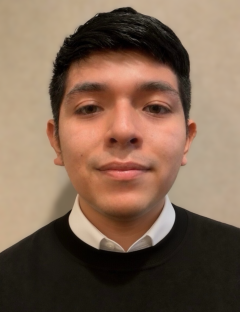
 When Johnny Guevara joined Weill Cornell Medicine's Research Associate Program, he was searching for a way to combine his interests in science, medicine, and service. What he found was far more than research experience. He found mentors, leadership opportunities, and a path that ultimately led to his acceptance into the NIH-supported Transition to Academic Careers (TRACS) Fellowship at SUNY Downstate.
A career changer with a background in applied mathematics, Johnny spent a year working in finance before realizing he wanted work that felt more meaningful. His long-term goal became becoming a physician-scientist, someone who could bridge clinical care, research, and community health. The Research Associate Program offered an opportunity to explore all three.
"I wanted to pursue health equity," Johnny says. "There's really something for everyone in the program."
Among the many projects he worked on, Veamos Juntos proved especially transformative. The initiative focused on improving telehealth access for Spanish-speaking families and exploring barriers to virtual care. While many assume access to technology is the primary challenge, Johnny's team found that perceptions and understanding of telehealth often play a larger role in whether patients use these services.
The project also allowed Johnny to take on significant responsibility. Working alongside mentors Dr. Maria Lame, Ariel Sulcov, Dr. Ji Won Kim, Will Simmons and Tenzin Diki, he helped redesign recruitment strategies, revise surveys, recode REDCap databases, conduct data analysis, and contribute to the scientific framing of manuscripts. Rather than simply observing research, he became an active contributor and leader.
"They welcomed that independence," he says. "That taught me more than being walked through everything ever could have."
For Johnny, the experience reinforced an important lesson: research can be a powerful tool for improving healthcare access and addressing disparities in underserved communities.
But some of the most influential experiences came from opportunities beyond his assigned projects. Through the program, Johnny participated in simulation training, helped prepare for BASE Camp exercises, and gained hands-on exposure to emergency medicine education. He also became a regular attendee at the Englander Institute's AI Clinic, where discussions about artificial intelligence, cloud computing, and healthcare innovation sparked a new interest in applying technology to public health challenges.
Inspired by those experiences, Johnny began developing his own proof-of-concept tools, including educational chatbots, data summarization tools, and AI-driven health applications. More importantly, he gained the confidence to pursue solutions to problems he encountered through his research.
That mindset eventually led him to launch SaludNYC.org, a project designed to make public health data more accessible and actionable for Spanish-speaking New Yorkers. Inspired by themes that emerged through Veamos Juntos, the platform helps residents better understand the health issues affecting their communities and connect with relevant local resources. Several fellow research associates have even contributed to the initiative's development.
"The environment here makes you believe in the work," Johnny says. "It gives you the confidence to want to build something of your own."
His growing commitment to health equity and community-based research helped him earn acceptance into SUNY Downstate's highly competitive TRACS Fellowship, a year-long NIH-supported research training program that prepares future leaders in biomedical and public health research. The fellowship provides intensive mentorship, research training, and opportunities to contribute to scientific publications and translational research projects.
The experience will allow Johnny to expand his focus from individual patient experiences to population-level health challenges. While much of his work at Weill Cornell Medicine centered on patient-facing interventions, TRACS will give him the opportunity to study healthcare disparities, community health, and systems-level factors that influence outcomes across neighborhoods and populations.
Looking back, Johnny credits much of his success to taking advantage of every opportunity available to him and building strong relationships with mentors along the way.
His advice for incoming research associates is straightforward:
Keep an open mind.
"Do the work you're assigned, but always ask questions. Find out what happens to the data. Ask to sit in on meetings. Volunteer for things. Some of the things that shaped me the most weren't the things I came here for."
Johnny's journey demonstrates what is possible when curiosity meets opportunity. Through the Research Associate Program, he discovered new interests, found mentors who encouraged him to grow, and developed the skills and confidence to pursue meaningful work in health equity research.
As he prepares to begin the next chapter of his career as a TRACS Fellow, his story serves as a reminder to current and future research associates: the opportunities are here. The key is being willing to pursue them.