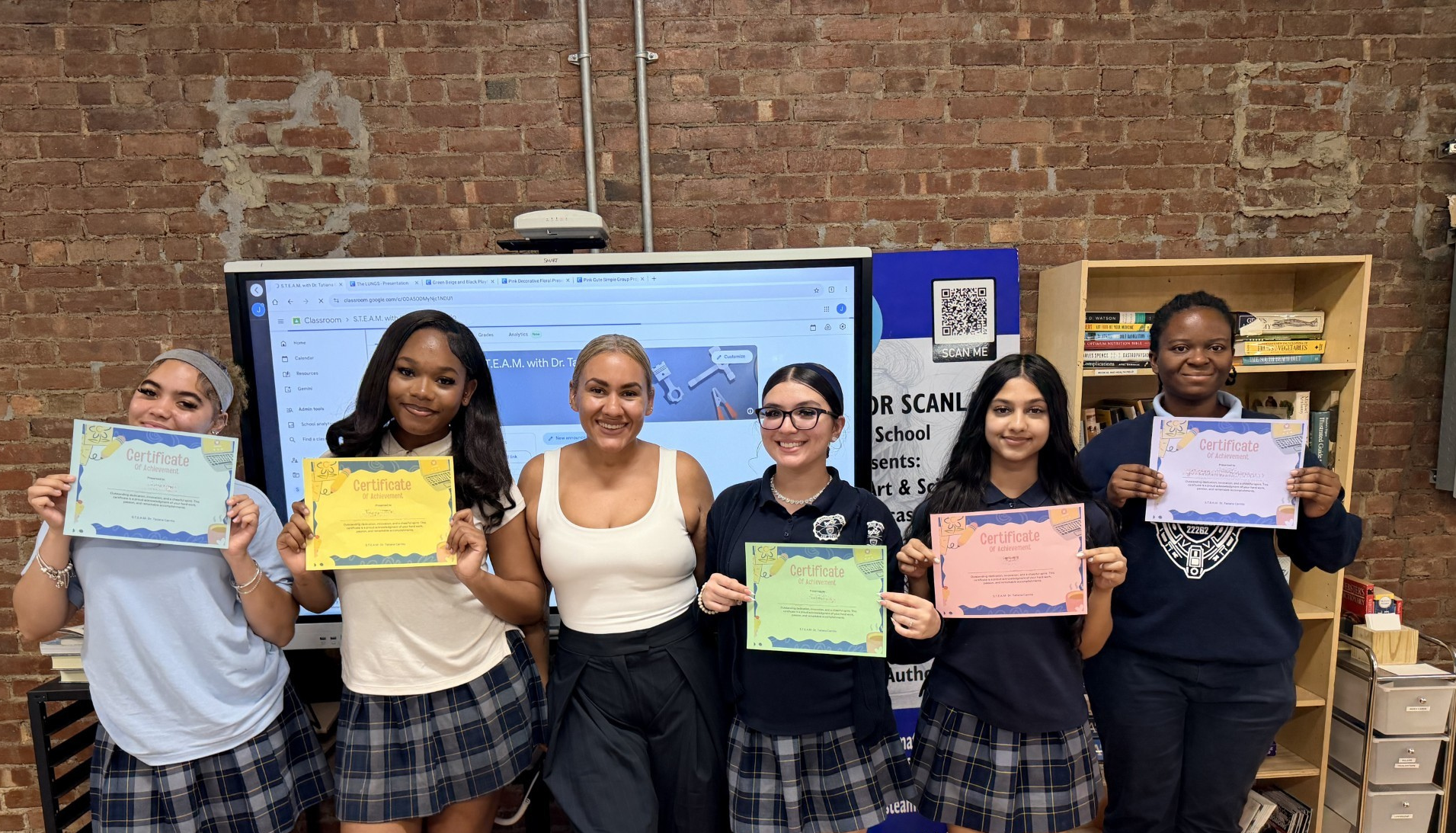
 For Dr. Tatiana Carrillo, emergency medicine is about more than caring for patients in moments of crisis. It is also about creating opportunities for young people who may not have access to the mentorship, resources and exposure needed to pursue careers in science and medicine. That commitment inspired the creation of Science Through Engagement, Action and Mentoring (STEAM), an educational program designed to introduce students from historically underrepresented communities to STEM and healthcare careers.
A collaboration between Monsignor Scanlan High School and the Weill Cornell Medicine Department of Emergency Medicine, STEAM provides students with hands-on scientific learning, career exploration opportunities and mentorship. Its mission is to foster critical thinking, problem-solving skills and a passion for academic medicine through experiential learning.
From South Bronx Student to Emergency Medicine Leader
The inspiration behind STEAM comes directly from Dr. Carrillo's own journey. Born and raised in the South Bronx, she grew up in a single-parent household alongside her younger sister. While both excelled academically, financial barriers and limited access to mentorship made the path to higher education and medical school more challenging.
As she pursued medicine, Dr. Carrillo participated in pipeline programs that helped her navigate the educational process. Even so, she often found limited guidance on applications, educational requirements and career decisions.
"I understand why it's easy to give up dreams and goals if you can't see them," she explains. "It's harder when you don't have someone to help you navigate those waters." STEAM was created from those lived experiences and a desire to ensure future students have the support she wished had been more readily available.
Building a STEM Pipeline for Underserved Communities
Dr. Carrillo launched STEAM in 2023 while working in Philadelphia, initially serving middle school students. After joining Weill Cornell Medicine, she brought the program to New York City, focusing on high school students in the South Bronx.
The program recruits students beginning in their sophomore year and supports them throughout high school. The inaugural New York cohort included eight students, while the newest cohort has grown to 11. The program also dedicates positions to students with individualized education plans, reinforcing its commitment to access and inclusion.
By targeting students with academic potential and an interest in science, STEAM helps cultivate future leaders who may otherwise lack access to mentorship and professional networks.
Hands-On Medical Education That Brings Science to Life
One of STEAM's defining features is its immersive curriculum.
Students participate in monthly sessions throughout the school year, following a curriculum modeled after foundational medical education. During their first year, they learn the structure and function of major organ systems, including the cardiovascular and respiratory systems. In later years, they build on that foundation through advanced scientific concepts, medical terminology and case-based learning.

Experiential learning is central to the program. Students study anatomy firsthand, explore physiology through interactive activities and learn how body systems work together. Ultrasound education is integrated throughout the curriculum, giving students exposure to medical imaging while teaching the science behind the technology. Participants practice scanning techniques, identify normal anatomy and discuss clinical applications of their findings.
At the end of each academic year, students present a medical topic of interest, demonstrating both scientific understanding and communication skills.
The Power of Mentorship
Beyond science education, STEAM places a strong emphasis on mentorship.
One of the program's core goals is to guide students throughout their educational journeys through encouragement, academic support and peer learning opportunities. As STEAM expands, Dr. Carrillo hopes to engage faculty members, residents, staff and specialty consultants to provide students with exposure to a variety of career paths.
She believes that exposure matters. When students interact directly with physicians, scientists and other professionals, they begin to envision themselves in those roles. That visibility helps transform careers that once felt out of reach into attainable goals.
Reconnecting With the Purpose of Medicine
Dr. Carrillo says working with young learners has helped her reconnect with the fundamental purpose of medicine. In a profession often defined by demanding schedules and high-pressure situations, spending time with curious and motivated students serves as a powerful reminder of why she entered healthcare.
By helping students understand how the human body works and encouraging them to explore scientific careers, she sees firsthand the transformative role education and mentorship can play in shaping futures.
Looking Ahead
Dr. Carrillo envisions STEAM growing far beyond its current reach. Her long-term goal is to create a continuum of support spanning elementary school through high school and eventually providing pathways to advanced degrees in medicine, law, science and other professions.
With support from the Department of Emergency Medicine, the program currently provides supplies, lunches, stethoscopes, reflex hammers, dissection materials and other educational resources. Future aspirations include developing scholarship programs, expanding funding opportunities and increasing direct support for students as they pursue higher education.
Helping Students See What Is Possible
At its core, STEAM is about possibility.
"The kids are magic," Dr. Carrillo says, describing the curiosity, resilience and desire to learn that she sees in every participant. Her philosophy is simple: students are far more than grades or test scores. Success in healthcare and other service-oriented professions depends on compassion, teamwork, perseverance and a commitment to community.
By providing mentorship, exposure, academic enrichment and support, STEAM is helping students realize their goals are within reach. As Dr. Carrillo often reminds her students, "You can't be what you don't see." Through STEAM, she is ensuring that more young people can see themselves as future physicians, scientists and leaders and helping them chart the path to get there.